By Cory Westlund, Owner — 3 Generations Land Solution
If you own rural property in Pasco County or the greater Tampa Bay area, you’ve probably seen it happen. What was once a clean, defined fence line has slowly disappeared under years of vine growth, encroaching brush, sapling trees, and thick Florida undergrowth. Fence line clearing is one of those jobs that landowners tend to put off — until the fence itself is damaged, the property line becomes unclear, or the encroachment onto a neighbor’s side becomes a real issue.
Whether you have a few hundred feet of property line to address or a half-mile of buried fence running through dense vegetation, professional land clearing services can get it done right — and help you maintain it long-term so you’re not starting from scratch again next season.
Here’s what you need to know before tackling an overgrown fence line on your Florida property.
Why Florida Fence Lines Get Out of Control So Fast?
Florida doesn’t give you much of a grace period. The combination of heat, humidity, and nearly year-round rainfall means vegetation grows relentlessly. Unlike northern states where growth slows in winter, a neglected fence line in Pasco County can look completely different from one rainy season to the next. The region’s sandy Myakka fine sand soils — common across much of West Central Florida — make it easy for root systems to spread laterally, which is part of why invasive species get such a foothold along disturbed edges like fence rows.
Common offenders along West Central Florida fence lines include:
- Muscadine and wild grape vines (Vitis rotundifolia) — they pull down fence posts and wire over time and are deceptively strong
- Brazilian pepper (Schinus terebinthifolia) — a Category I invasive shrub that spreads rapidly along property edges, roadsides, and drainage ditches
- Smilax / greenbrier (Smilax spp.) — thorny, aggressive, and nearly impossible to clear by hand without serious effort
- Cogongrass (Imperata cylindrica) — a federally listed noxious weed that establishes dense mats and spreads through underground rhizomes
- Water oak and sweetgum saplings (Quercus nigra / Liquidambar styraciflua) — sprout along fence rows and grow quickly into small trees if left alone
- Air potato vine (Dioscorea bulbifera) — can drape an entire fence line in a matter of weeks during the summer rainy season
Once any of these plants get established along a fence line, they don’t slow down. Left unchecked, overgrown fence lines can physically damage posts and wire, create liability when vegetation crosses property boundaries, make fence inspection impossible, attract snakes and wildlife near working areas, and lock you out of your own property boundary.
What We Typically Find When We Walk an Overgrown Fence Line?
When we assess a fence line that’s been left to grow for more than a season or two, it’s rarely just one problem. It’s layered. Air potato or greenbrier vine crept along the outside of the fence wire first, giving Brazilian pepper seedlings the shaded, moist cover they needed to establish underneath. Old wooden posts look intact from 20 feet away but have rotted through at the base because vine growth held moisture against them for years. Wire that should be visible is buried under 3 feet of growth and can’t be inspected without clearing first.
That’s what we’re actually working with on most rural fence lines in Pasco County. The amount of time we need, and the equipment we choose, is shaped by what we find underneath — not what it looks like from the road.
What Does Fence Line Clearing Actually Involve?
Fence line clearing is more nuanced than running a mower along a property edge. Depending on the condition of the vegetation, the type of fence, and the terrain, the right approach will vary.
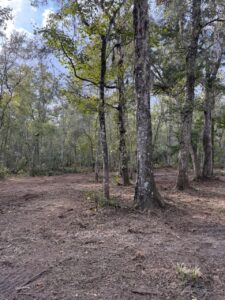
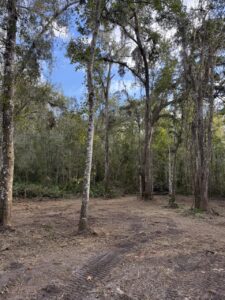
For lighter overgrowth — vines, tall grass, small brush — a forestry mulcher is often the right call. It grinds vegetation in place and leaves a layer of organic material on the ground without disturbing your soil or damaging the fence itself. There’s no hauling, no burning, and the line looks clean quickly.
For heavier encroachment — large shrubs, established trees growing through the fence, or root systems that have wrapped around posts — traditional equipment may be needed alongside or instead of mulching. In some cases, the old fence needs to come down before clearing can begin, especially where vines and root systems have compromised the posts and wire beyond saving.
A professional crew assesses the condition before starting, determines what equipment makes sense, and works carefully around any fence structure worth preserving.
Does Fence Line Clearing Require a Permit in Pasco County?
Most routine fence line vegetation management — brush, vines, and small saplings — does not require a permit in Pasco County’s unincorporated areas, especially on agricultural or rural residential land governed by the county’s Land Development Code. However, if large-diameter protected trees need to be removed, or if the fence line runs near a wetland buffer, drainage easement, or conservation corridor, those situations warrant a call to Pasco County Development Services or the Southwest Florida Water Management District (SWFWMD) — the region’s wetland and environmental resource permitting authority — before any clearing begins.
If your property falls within the city limits of New Port Richey, Port Richey, Zephyrhills, or Dade City, city ordinances apply instead of county rules — always confirm jurisdiction before assuming.
A reputable land clearing services contractor will help you identify potential issues during the property walkthrough rather than leaving compliance questions for you to sort out after the fact.
How Long Does Fence Line Clearing Take?
That depends on your property. The length of the fence line, the density of the vegetation, the terrain, any wet or soft areas that might limit equipment access, and how overgrown things have gotten all factor into a realistic estimate.
A clean line with light brush and vines might be cleared in a day. A quarter-mile of fence buried in Brazilian pepper and thorny vines, with posts wrapped in root systems, will take longer — and anyone giving you a hard timeline without walking the line first isn’t giving you an accurate picture. We don’t.
Maintaining Your Fence Line After Clearing
Once the line is clear, keeping it that way is much easier — but Florida vegetation doesn’t rest.
- Annual or semi-annual clearing is typically enough after an initial hard clear to keep most lines manageable
- Mulched fence lines naturally suppress regrowth for a season or two, reducing maintenance frequency
- Targeted follow-up treatment for persistent invasive species by a licensed herbicide applicator can extend the time between service visits significantly
Many landowners — particularly those running cattle or horses — set up a recurring maintenance schedule with their clearing contractor so the fence line never gets away from them again. That’s by far the most cost-effective approach in the long run.
We Know This Ground
At 3 Generations Land Solution, fence line clearing is a regular part of the work we do across Pasco County and the surrounding region — Wesley Chapel, Zephyrhills, Dade City, Spring Hill, New Port Richey, Hudson, and beyond. We’re a veteran-owned, family-operated business serving West Central Florida, and we’ve handled everything from light suburban property lines to half-mile rural fence rows on working farms that hadn’t been touched in a decade.
We’ll walk the line with you, tell you exactly what we’re looking at, and give you a straight answer on what it’ll take to clear it properly.
📞 Call (727) 261-1018 or visit 3generationslandsolution.com to schedule your free property assessment.
Frequently Asked Questions
Can I clear my own fence line?
For light brush and vines, some landowners manage routine maintenance themselves. For established overgrowth, invasive species, or vegetation that has wrapped into the fence structure, professional land clearing services will save you significant time, effort, and the real risk of damaging the fence further.
Will clearing damage the existing fence?
A professional crew works carefully around existing fence structures. If the fence is already compromised — posts rotted, wire buried and tangled — that’s identified during the assessment upfront so you know what you’re working with before anything starts.
How much does fence line clearing cost?
Pricing depends on linear footage, vegetation density, terrain, and the equipment the job requires. We don’t give flat-rate estimates without seeing the property — contact us for a site-specific quote.
What’s the difference between fence line clearing and a property survey?
These are separate services. A land survey establishes and legally documents your property boundaries. Fence line clearing removes vegetation along a fence or boundary line. If you’re not certain where your property line actually runs, it’s worth having it surveyed before clearing begins — especially on rural parcels where fence lines may have shifted over time or may not follow the true legal boundary.

Cory Westlund
Cory Westlund is the owner of 3 Generations Land Solution, a veteran-owned, family-operated land clearing company serving Pasco County and West Central Florida. He and his crew handle fence line clearing, forestry mulching, and land clearing across the region — from light suburban property lines to half-mile rural fence rows on working farms.